Spiritual Whispers TM
Tarot Cards: Understanding Tarot Readings
Exploring Tarot Card Readings and Their Spiritual Meaning
Tarot cards have been used for centuries as a tool for reflection, spiritual exploration and
personal insight.
A tarot deck contains a collection of illustrated cards, each carrying its own traditional symbolism and possible interpretations. During a tarot reading, the cards are selected and interpreted in relation to a question, situation or area of life.
People explore tarot for different reasons. Some are interested in understanding their feelings, others want to reflect on personal choices, and some are curious about the spiritual symbolism associated with the cards.
Learning about tarot can provide an introduction to a longstanding practice that combines imagery, symbolism and individual interpretation.
Understanding the Tarot Deck
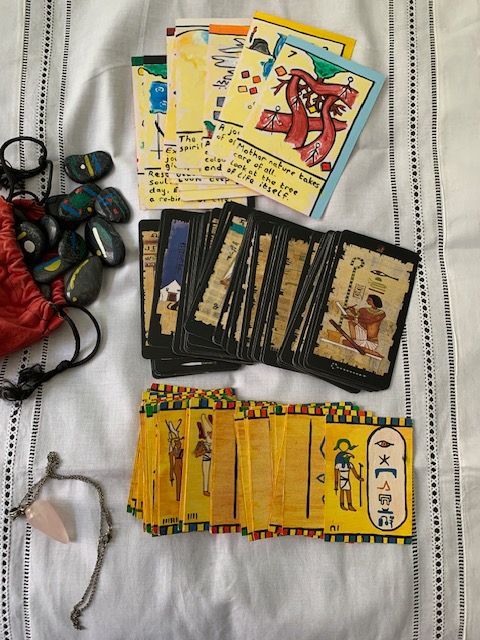
A tarot deck is traditionally made up of 78 cards, divided into two main groups known as the Major Arcana and the Minor Arcana.
Each card features its own imagery, symbolism and traditional meaning, which can be interpreted in different ways depending on the context
of a reading.
The Major Arcana consists of 22 cards, including The Fool, The Magician, The High Priestess and The World. These cards are often associated with significant themes, personal experiences and stages of life.
The Minor Arcana contains 56 cards divided into four suits: Wands, Cups, Swords and Pentacles.
Each suit is traditionally connected with different aspects of everyday life, such as creativity, emotions, thoughts, practical matters and
material concerns.
Although many tarot decks follow this traditional structure, the artwork and presentation can vary considerably.
Exploring the cards and their symbolism is one way to become familiar with the history and practice of tarot.
How Tarot Card Readings Work
A tarot reading generally involves selecting cards from a deck and interpreting their imagery and traditional meanings in relation to a particular question or situation.
Before a reading begins, the person seeking guidance may focus on a subject they would like to explore, such as a personal decision, a relationship or a period of change.
Different arrangements, known as tarot spreads, can be used to organise the cards. A simple three-card spread, for example, might represent the past, present and future, or explore a situation, its challenges and possible approaches.
Larger spreads may use additional cards to examine a subject from several perspectives.
The interpretation depends on the cards selected, their positions within the spread and the reader's understanding of their symbolism. Some readers also consider whether a card appears upright or reversed.
Tarot readings are interpreted differently by different practitioners, and their results should be viewed as a form of spiritual exploration or reflection rather than guaranteed predictions.
Exploring Tarot Card Meanings and Symbolism
Tarot cards contain a variety of images, colours, figures and symbols, each of which can contribute to their traditional interpretation.
Some cards feature familiar themes such as beginnings, change, uncertainty, achievement or personal development.
Understanding these themes can help explain why particular cards have become associated with certain experiences and situations.
For example, The Fool is commonly associated with new beginnings, taking a step into the unknown and the possibility of discovery. The Hermit is often linked with introspection, solitude and the search for understanding, while The Star is traditionally associated with hope, renewal and inspiration.
These interpretations provide starting points, although the meaning of a card can vary according to the question and the surrounding cards.
Learning about tarot symbolism does not necessarily mean memorising a fixed meaning for every card. Many people explore how the imagery relates to their own thoughts, experiences and perspectives.
This combination of traditional meanings and individual interpretation is an important part of how tarot is approached by many practitioners.
Why Do People Explore Tarot?
People explore tarot cards for a variety of reasons. Some are interested in the spiritual traditions associated with the cards, while others are curious about their symbolism or want a different way to reflect on personal experiences.
Tarot can provide a structured opportunity to consider a question, identify concerns and look at a situation from more than one perspective.
Some people turn to tarot when facing a decision or a period of uncertainty. The cards may prompt them to think about their priorities, feelings, expectations or possible courses of action.
Others enjoy studying the artwork and traditional meanings as part of a wider interest in spirituality, symbolism and divination.
It is worth remembering that tarot cards cannot guarantee future events or provide definitive answers to every question.
Their interpretations are subjective, and important decisions are best considered alongside practical information, personal judgement and appropriate professional advice where needed.
For many people, the interest lies in the process of reflection and the opportunity to explore ideas they might not otherwise have considered.
Tarot Cards and Oracle Cards: What's the Difference?
Tarot cards and oracle cards are both used in spiritual practices and divination, but they generally differ in their structure.
Traditional tarot decks usually contain 78 cards divided into the Major and Minor Arcana, with established suits and a recognised sequence of cards. Although individual tarot decks may use different artwork or interpretations, they tend to follow this familiar framework.
Oracle decks are more varied. They can contain any number of cards and may focus on subjects such as spiritual messages, personal reflection, nature, mythology, affirmations or symbolic themes.
Unlike traditional tarot, oracle cards do not follow one standard structure, allowing their creators greater freedom in how the cards are designed and interpreted.
Neither approach is identical for every practitioner. Some people prefer tarot because they enjoy studying its established symbolism, while others are drawn to the variety and flexibility of oracle decks.
Some use both, depending on the type of reflection or spiritual exploration they wish to undertake.
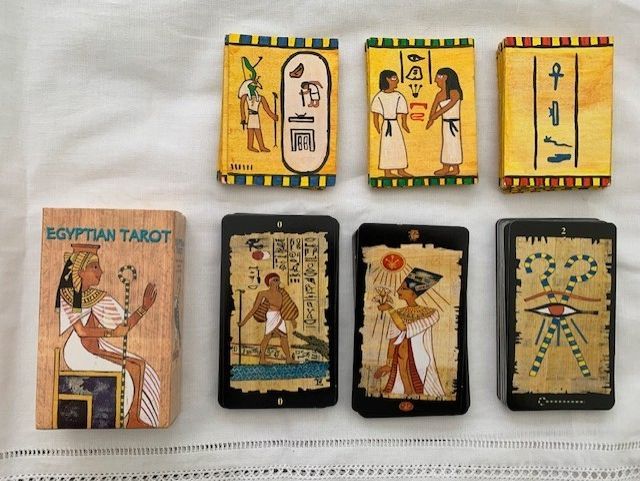
At Spiritual Whispers, you can explore the Egyptian Oracle of Three Realms, a digital product inspired by Egyptian symbolism.
This offers a way to discover a different form of card-based spiritual exploration beyond the traditional tarot deck.